From our inbox: I have an incredibly strange question and I hope the Historical Society is right place to ask it.
My grandfather wrote a book about his life in Vermont and he told this hilarious but strange story about running out of gas in the middle of the night in Randolph in 1953. He told of being rescued by what he described as the “Town Watchman on a bike with a clock.” I’m including the relevant passage below. He had a footnote in this chapter saying he intended to write the town of Randolph and ask if his “guardian angel” was real. I don’t think he ever did, but I’m wondering if you could shed some light on this. Does the guy described below sound like a person/position that has ever been employed by the Town of Randolph? Was the man’s method of proving his wakefulness actually how somebody kept track of him?
I would love any information whatsoever about this or even slight confirmation of the veracity of this story. But if you can’t find anything, enjoy a snippet of my Grandpa’s storytelling.
I did not know anything about this story but I knew who might, the “You Know You Are From Randolph When…” Facebook group. This was what I relayed back to the man who emailed.
The man’s name was Dave Barcomb. He had one arm. I have not seen… if he has any direct living relatives in town but a few people claim to be related to him.
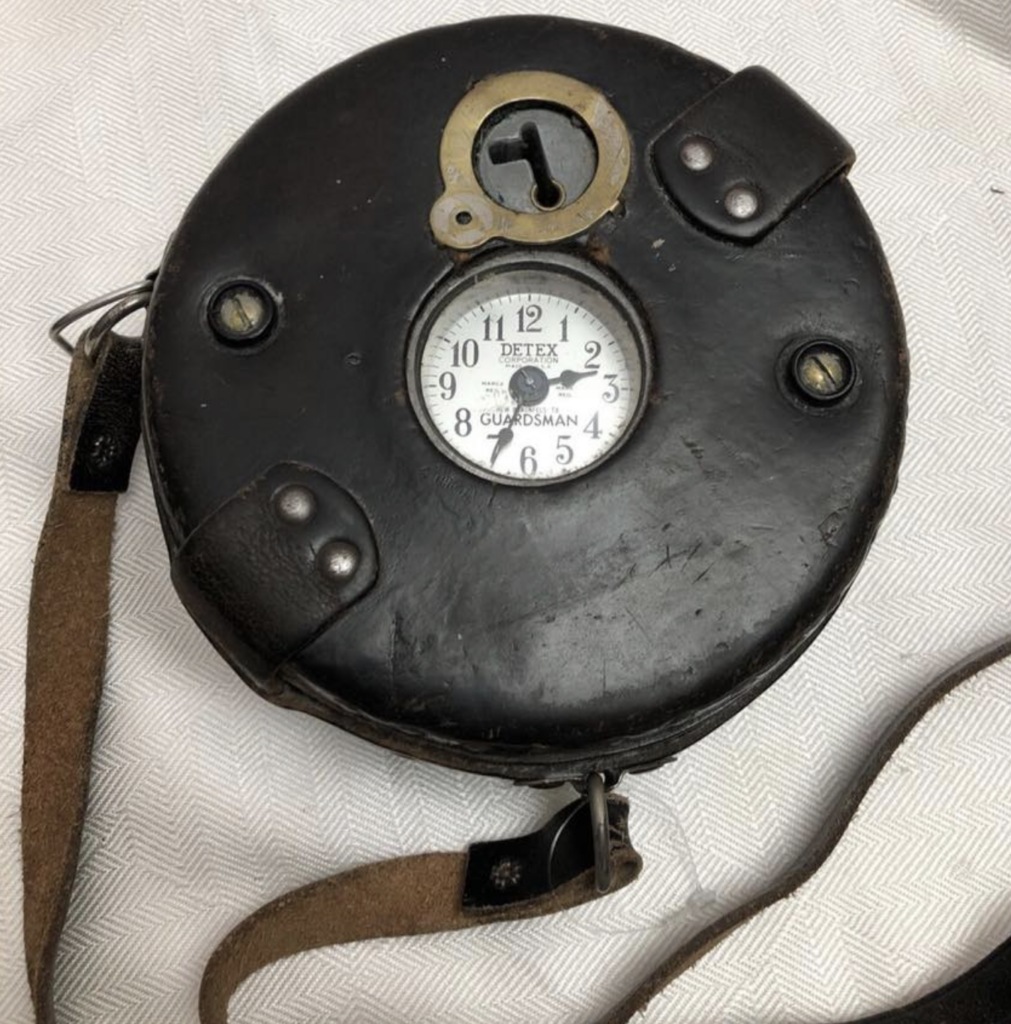
Apparently the system was such that YES he did wear a clock around his neck. Per one of the people in the group:
“The ‘watchclock’ was a large and heavy leather encased clock that had a paper tape in it. Each time he took a watchkey, that was attached to each ‘watchbox’ a matchbox sized cast iron box with a flip up lid that was bolted to the building, he turned the key in the clock showing he had been there. This way a permanent record was made as to when each business was checked. You can see the remains of these on several buildings in town. It was a round clock like the one pictured with the box and key.”
A woman wrote in to us with images of a dry sink she had in her possession, wanting to know more about the man who made it.
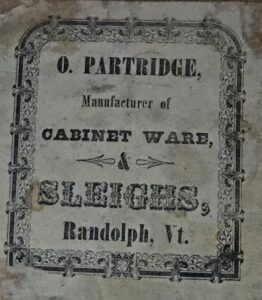
A lot of what we know about Oramel Partridge is from public records. He was born in 1799 and died in 1868. He had a wife, Lucy and several children at least one of whom grew into adulthood. He made cabinets and sleighs as you can see from the label. Here’s a link to his FindAGrave page
He was, as near as I can tell, a descendant of people who were early colonists of the US. You can see more at this link on FamilySearch with a (free) login.
Very few of his creations survive, possibly only one or two. Here is a short quote from an article I read which noted him in Antiquities and Fine Art Magazine in 2015.
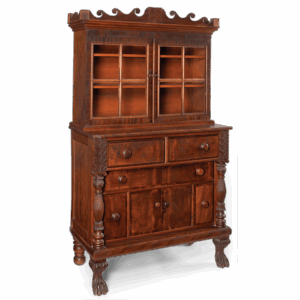
“Oramel Partridge, born in Norwich, Vermont, learned his trade from Isaac Reed in Randolph, where he opened a cabinetmaking shop in 1822 and where he remained his entire life. This sideboard/bookcase represents his only known surviving work. It was commissioned by Aaron Storrs, who was a charter member of the town of Randolph, Vermont, in 1781, and silently proclaims his status in the community.”
I’m attaching a photograph of the item from that article.
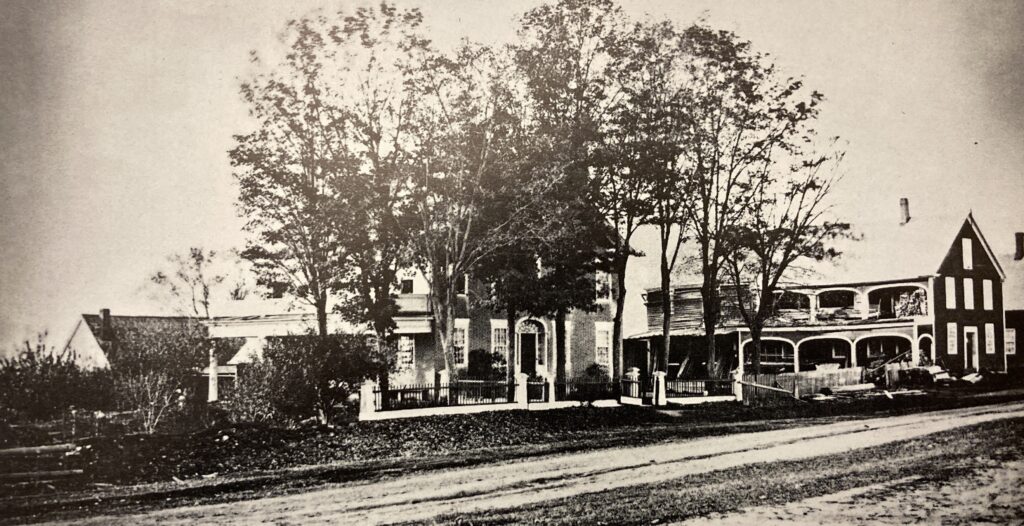
From Wes Herwig’s book Early Photographs of Randolph, Vermont, we have an image of his home. The caption reads, in part: “Oramel Partridge built this brick house in 1828, and operated a cabinet shop and sleigh works next door. Some time after his death in 1868, the shop was moved across the street.”
Luther Tucker (L.T.) Sparhawk (February 11, 1831 – March 4, 1918) was an early American photographer from Randolph, Vermont.
Luther Tucker Sparhawk was one of Randolph’s early photographers. While also working as a coal dealer, he had a photography studio in six different places in downtown Randolph. RHS has a collection of his photographs which we’ve made available online. We also assembled what we could find out about him into this Wikipedia article. Links go to other pages on Wikipedia.
Early Life
Sparhawk was born in Rochester, Vermont, the son of Samuel Sparhawk and Laura (Fitts) Sparhawk, one of eight children. He moved to Randolph, Vermont in 1842 and spent the rest of his life there. His early profession was as a maker and tuner of melodeon reeds and he would often assemble other things for friends and family including fishing rods and childrens’ toys. He also worked as a coal merchant.
Career
Sparhawk entered photography by learning to make ambrotypes from R. M. Macintosh in Northfield, Vermont and set up his own studio in Randolph, Sparhawk Studios. While he worked for the rest of his life, the studio itself was located in six different downtown locations and sometimes co-located with a photography retail store and a hair salon.
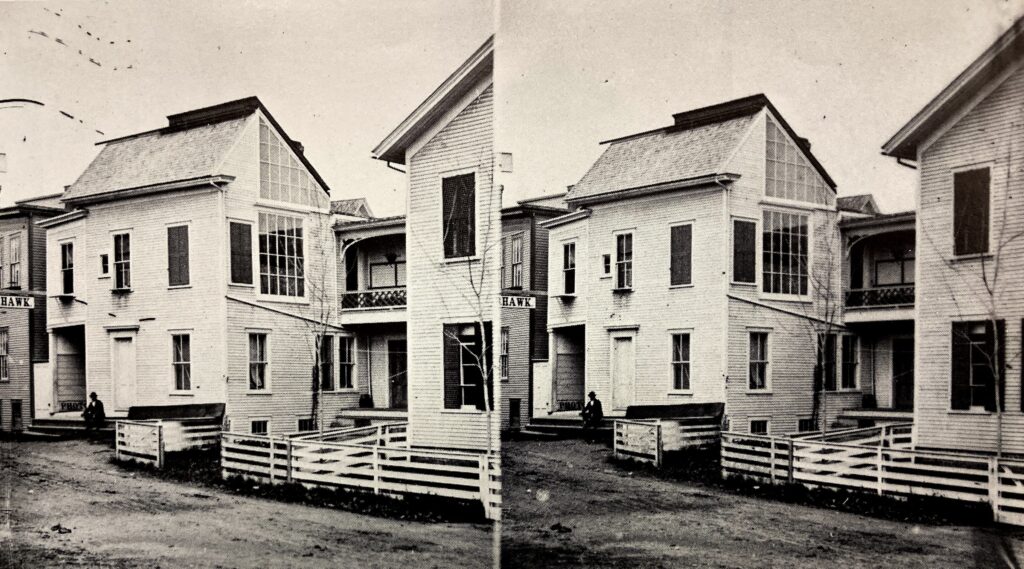
Sparhawk’s Studio on Merchant’s Row c. 1869
He was a progressive photographer, often trying new styles, and there are extant images from him in ambrotype, tintype, glass negative and daguerrotype formats. He was said to be one of the first New Englanders to use the “dry plate” method of photography, and retouch negatives. He designed many of his own mechanisms including his own shutters for high speed photography and assisted other novice photographers with their mechanical photographic issues.
Sparhawk was an early popularizer of dry-plate photography in the region. His studio would give away dry plate cameras as a loss leader on the condition that people agreed to buy their glass plates from the studio. The studio also sold photographic frames. His daughter Blanche assisted him in the studio until she was married.
He married Josephine Bean on October 31, 1860. They had seven children, three of whom lived to adulthood: George, Willis, and Blanche. His wife predeceased him, dying on November 24, 1915 . Sparhawk died of pneumonia on March 4, 1918.
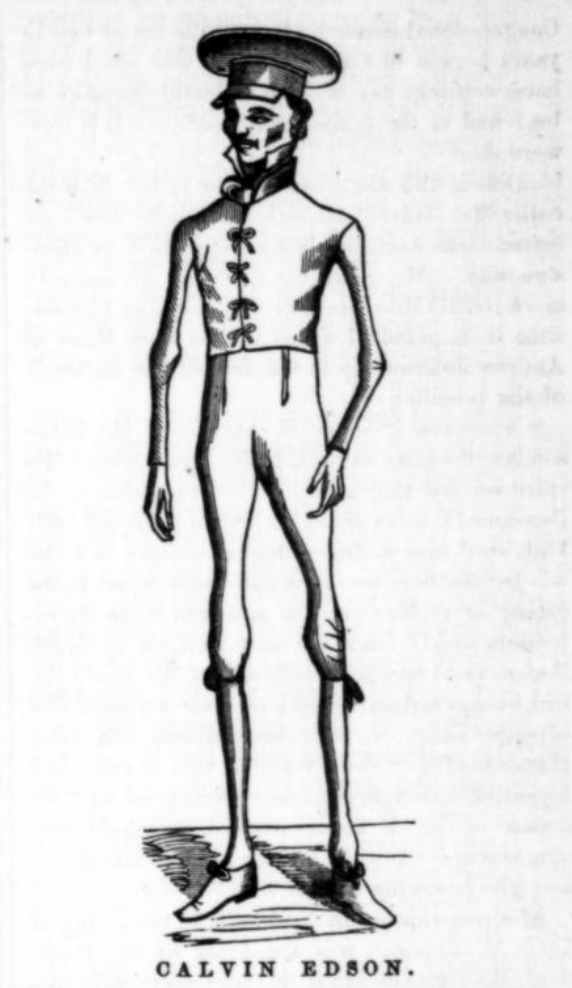
One of the questions we get asked at the RHS is whether we have Calvin Edson’s suit. Edson was A Randolph native who went on to serve in the Army and toured in a circus sideshow. We didn’t know much about him so we did some research and started this Wikipedia article so more people could learn about him. We have not yet found his suit!
Calvin Edson (born March 4, 1788) was an American man known for being the first well known “Living Skeleton” in American sideshows.
Early life
Edson was born in 1788 in Stafford, Connecticut to Eliab and Prudence Edson and the family moved to Randolph, Vermont shortly after he was born. He was one of eleven children. He had one brother, Alexander, who was also emaciated in appearance.
Edson fought in the Battle of Plattsburgh as a member of the 11th Regiment. After a period of living outdoors with his regiment in 1814 he began to lose weight rapidly. He was 5 feet 3 or 4 inches tall and eventually reported to weigh only 45 pounds. Other than his emaciated appearance, he was in decent physical health.
Sideshow performing
Edson performed as the Living Skeleton in circus shows, wearing a tight-fitting black suit, the first popular “skeleton” performer. In 1831 he traveled to Europe where his promotional materials said that he had been “introduced to the College of Physicians and Surgeons” in Paris where he was claimed to have been called “the greatest phenomena of nature the world has ever beheld.” Edson traveled around the US with broadsheets announcing his performances where he put himself on display and also danced. These broadsheets had illustrations of Edson on them and were later reproduced in newspapers. He was said to have earned $15 a week for his work.He performed in a theater production as a character called Jeremiah Thin.
Edson’s death was reported in newspapers nationwide in 1832 attributed to oculist John Scudder Jr. of Scudder’s American Museum. It was claimed that his body was stolen from its tomb and inspected, and he was said “to have had a tapeworm twelve to fourteen feet in length.” He was, in fact, alive and had just been on a short trip. Edson toured several museums in New York through the 1830s.
Personal life
Edson was married to Rachael Cutler Edson in 1822 and had four children; two of his daughters were deaf and mute.
[Alexander Twilight, not Ben Robinson, Randolph resident from 1815-1821]
Randolph’s early history predates the history of Vermont. The first people to settle this area “from away” were in the East Valley, near the Second Branch of the White River where there was a rudimentary route to Canada as well as backcountry trails used by indigenous residents and transient trappers and traders. The first white settlers squatted the land that was to become Randolph in the 1770s and the town was established shortly thereafter in 1781. Vermont entered the US in 1791.
Older accounts of the state mostly discuss the achievements of these white men and the history of Vermont, including the fact that the early Vermont Republic banned adult slavery. However, the legacy of Black people’s experiences in Vermont were not quite as straightforward or well-documented.
Alexander Twilight, whose life has been extensively researched, did six years of schooling at Randolph’s Orange County Grammar School–on what is now the VTSU campus–but eventually settled in Middlebury.
Ben Robinson was one of the first documented African American people to have settled in the Randolph/Braintree area, but people mostly only know him from his gravestone in the South View Cemetery. Here’s what else we know about him–his story has a lot of familiar Randolph names and places in it.
According to the Herald, Robinson was born an enslaved person in New Bern, North Carolina. Members of the Ninth Vermont Regiment encouraged him to come North with them when he was a teenaged boy. He left with them in 1863 where he worked for and possibly fought alongside members of the regiment. At the time, his surname was Furbey after the family who had enslaved him. He changed it to Robinson, the name “of an earlier master,” which was the name he preferred.
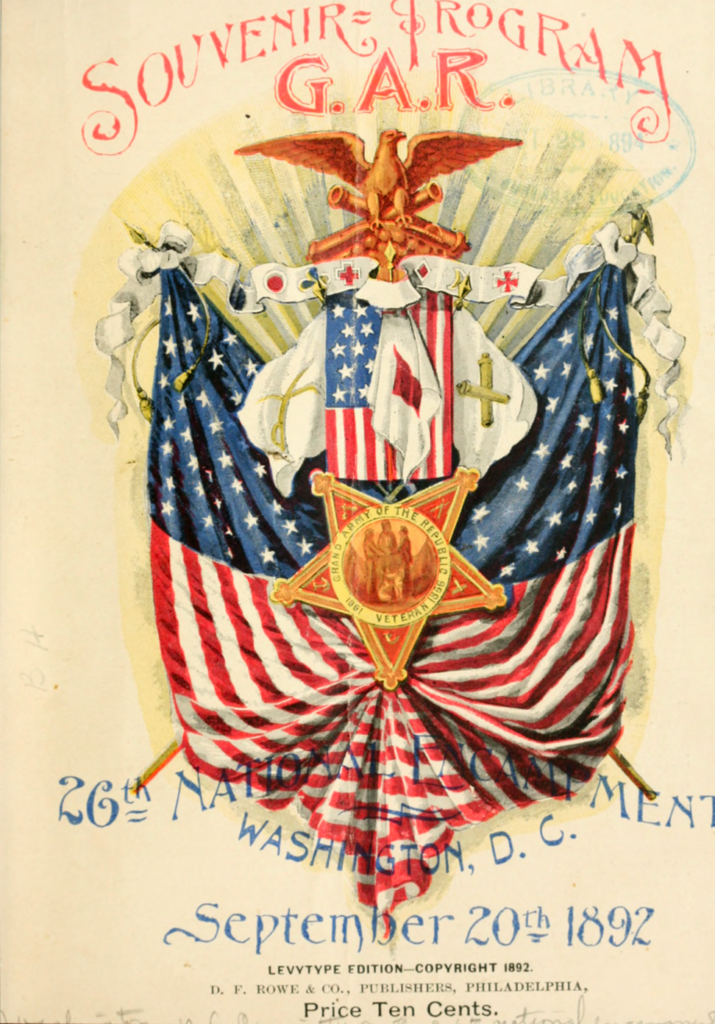
[Souvenir program from the 1892 National Encampment]
He arrived in Vermont after the war in 1865, working for Lieutenant William Holman. Holman, who lived in Braintree, sent the young Robinson to school “with white boys” and staked him $200 (about $5000 in today’s money) to set up a life for himself upon his 21st birthday.
Of note is the fact that while Vermont did not allow “adult slavery” there were many loopholes in this provision allowing for both indentured servitude and legal enslavement of children. These loopholes were finally closed by a statewide vote in 2022. Robinson’s status as a free man is not entirely clear until the point at which he left Holman’s home.
He remained close with veterans. In 1892 he went to Washington DC with his comrade John Manney for the annual G.A.R. (Grand Army of the Republic) National Encampment, a nationwide veterans gathering. He attended to try to get more information about what had happened to his father, but he was unsuccessful.
Robinson died a few years later of heart disease on June 2nd, 1910, at Park Street home of Charles Flint where he was living. His obituary describes him as the only Black person in Randolph, “honest, quiet, well-meaning and worthy of respect.” The pallbearers at his funeral at the Methodist church were John Manney and three of his classmates: E. S. Abbott, Allen Flint Jr., and Henry Seymour. Robinson was said to have had “a little property” but left no will so it is believed that, after his burial expenses were paid, his estate went to the town.
A version of this article appeared in the Randolph Vibe and the White River Valley Herald
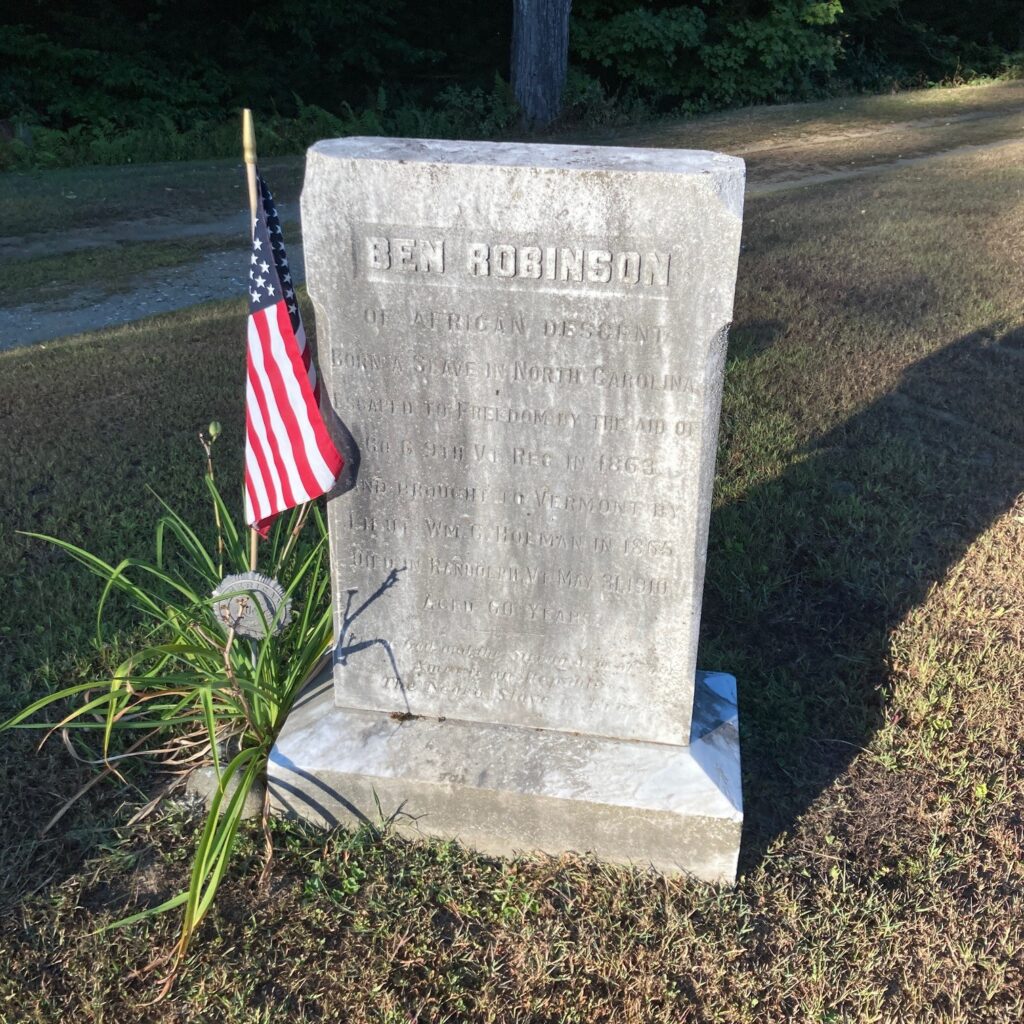
His gravestone, made of Italian marble, was placed in the South View Cemetery by the U. S. Grant Post No. 96 of the G A.R. on Memorial Day 1912. It reads, “Ben Robinson of African descent born a slave in North Carolina. Escaped to freedom by the aid of Co. G, 9th VT Reg. in 1863 and brought to Vermont by Lieut. Wm. G. Holman in 1865. Died in Randolph, VT May 31, 1910 aged 60 years. Under God and the Strong Arm of our American Republic, the Negro Slave is Free.” Next to it is a G.A.R. medallion and an American flag. Someone regularly places flowers beside it.